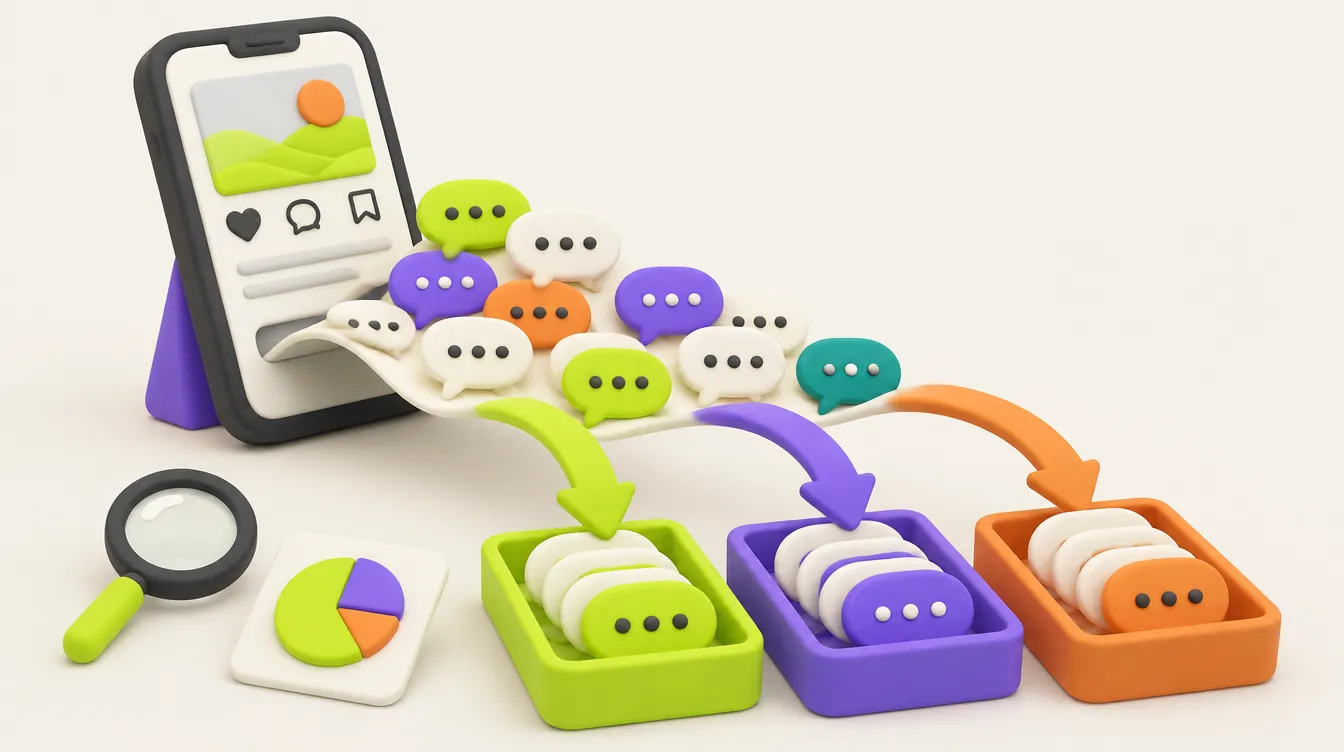
- Sample on purpose: 30–50 comments from each of 3–6 posts, chosen to cover different post types, gives you 100–300 comments, enough to see the main themes.
- Code every comment into one theme from a short codebook: questions, objections, praise, requests, purchase signals and noise. Count, then read again.
- Sentiment scores hide the useful part. In our Starbucks sample, many “negative” comments were people who wanted a product and couldn't get it.
- Turn questions into content, objections into ad angles, and requests into product or launch decisions, each backed by a count.
How to sample comments so the themes hold up
Comment sections are noisy and uneven. A few posts attract most of the comments, and the loudest commenters aren't always typical. A deliberate sample fixes most of that.
- 1
Start from a question
Decide what you want to learn before you collect: objections to a product, questions people ask before buying, what fans love about a competitor, or reactions to a launch. The question decides which posts to sample.
- 2
Pick 3–6 posts of different types
Choose posts that cover the range: a product launch, an everyday post, a promotion, a collaboration. Sampling only the most-commented post gives you one conversation, often about one thing. If you're researching a competitor, include their best and their most typical posts.
- 3
Take 30–50 comments per post
That gives 100–300 comments in total, which is usually enough for the top five themes to settle. After about 100 comments, new comments mostly repeat existing themes; when that happens, you can stop.
- 4
Know which comments you're getting
Platforms show comments in different orders: most recent, most liked or a ranked mix. Recent comments show what people say now; top comments show what the crowd agrees with. Write down which you used, because it changes the result.
- 5
Keep replies separate
Replies are often arguments between commenters or answers from the brand. They're useful context but can double-count a theme. Code top-level comments first, then read replies under the biggest themes.
- 6
Remove duplicates and spam
Some accounts paste the same comment on several posts, and some comments are promotions for other accounts. Flag them so they don't inflate a theme. Don't record commenters' usernames in your notes; you only need the theme and a paraphrase.
How to code comments into themes
Coding means giving each comment a label from a short, fixed list, then counting the labels. It sounds academic, but it's what turns a pile of comments into a finding you can defend: “one in five comments asked us to bring back a discontinued product” carries far more weight than “people seem to miss some old drinks”.
Start with a codebook of six to ten themes. Use broad types first (questions, objections, praise, requests, purchase signals, noise), then split a type into specific themes once you see what comes up. For example, “questions” on a product drop might split into price, availability by country and how to buy. Give each comment one primary theme. If a comment fits two, choose the one that would lead to a different action.
Code the first 30 comments, then review your codebook. Merge themes with only one or two comments and split any theme that holds more than a third of the sample. Then code the rest. If two people are coding, have both code the same 30 comments and compare; where you disagree, tighten the theme definitions.
Finally, count each theme per post and overall. The per-post split matters. A theme that appears on every post is about the brand. A theme that appears on one post is about that post.
A starter codebook you can copy
Use these as your first set of themes and adapt the specifics to your category.
- Question: price (how much, is it worth it).
- Question: availability (which countries, which stores, online or in store).
- Question: product details (size, ingredients, compatibility, how to use).
- Objection: price or value (too expensive, cheaper elsewhere, smaller portions).
- Objection: quality or experience (taste, performance, service).
- Objection: access (sold out, not sold in my country, drop times).
- Praise: product (loves it, bought it, favorite).
- Praise: content or brand (funny, great campaign, good social team).
- Request: bring back or restock a product.
- Request: launch in a new market or format.
- Purchase signal: says they bought, will buy or want it.
- Noise: emoji only, tagging friends, greetings, unrelated comments, spam.
105 comments under three Starbucks Instagram posts, coded
We pulled 35 of the most recent visible comments from each of three Starbucks Instagram posts in November 2026: a Reel announcing collectible bear cups (3,051 comments in total at the time), a carousel for a hand-sanitizer collaboration with Touchland (1,214) and a carousel showing the holiday drinks menu (587). Each comment was given one theme. Examples are paraphrased and no commenters are named.
Access themes (sold out, not in my country) outweigh celebration.
See the full table
| Theme | Bear cups Reel | Touchland collab | Holiday drinks | Total | Paraphrased example |
|---|---|---|---|---|---|
| Bring back a discontinued item | 1 | 2 | 17 | 20 (19%) | Several asked when the Chestnut Praline Latte is coming back; others missed a discontinued breakfast sandwich and the old chai |
| Bought it or which one I got | 10 | 7 | 0 | 17 (16%) | People listed which bear cups they got, one after queuing before dawn |
| Sold out, missed the drop, drop timing | 6 | 10 | 0 | 16 (15%) | Several said the collab sold out before the announced 9am start |
| Not available in my country | 9 | 5 | 0 | 14 (13%) | Requests from Brazil, Spain, Belgium, the UK, India, the UAE, Canada and the Caribbean |
| Praise or wanting it | 2 | 2 | 5 | 9 (9%) | Love for the white holiday cup; one praised the social team directly |
| Purchase and product questions | 2 | 3 | 3 | 8 (8%) | Price, whether the cups go on sale online, whether a cup is reusable |
| Price or portion complaints | 1 | 2 | 2 | 5 (5%) | Drinks not filled to the top; the collab price felt too high |
| Other negative (taste, plastic, leaving) | 0 | 0 | 4 | 4 (4%) | One regretted trying two new holiday drinks |
| Asking for free product | 1 | 1 | 0 | 2 (2%) | The same request pasted on two posts |
| Noise: emoji, tags, greetings, unrelated | 3 | 3 | 4 | 10 (10%) | Emoji-only replies and tagged friends |
What it tells you
- The holiday drinks post was mostly about a drink that wasn't on it: 10 of its 35 comments asked for the Chestnut Praline Latte. That's a clear, countable product request.
- On the merchandise posts, access was the story. Sold-out and not-in-my-country comments made up 30 of 70 comments (43%), more than people celebrating what they bought (17).
- About one in five comments (23 of 105) was a direct question. Each one is a ready-made topic for a post, a Story or an FAQ.
- Only 9 comments (price, portion, taste and other complaints) criticized the product or brand itself. A sentiment tool would have scored far more as negative, because disappointment about missing out reads as negative too.
Two accounts pasted the same comment on two of the posts; we counted each occurrence, which affects 4 of the 105. These are the most recent comments at collection time, not the most liked, so they reflect the conversation a week or more after posting.
Sources: Starbucks bear cups Reel · Starbucks x Touchland post · Starbucks holiday drinks post · Starbucks on Instagram
Why sentiment scores mislead
Most comment tools start with a positive, neutral or negative score. It's quick, but it throws away the reason behind the feeling, which is the part you can act on. Here's how some of the comments in our sample would typically be scored, and what they actually tell a marketer (all paraphrased).
| Comment (paraphrased) | Typical sentiment score | What it actually tells you |
|---|---|---|
| A sad-face reply saying they didn't get any of the cups | Negative | Unmet demand. This person wanted to buy and couldn't. |
| Asking the brand to bring back a seasonal latte, again | Negative | A loyal customer naming a product they would pay for. |
| Saying the product isn't sold in their country | Negative | A market-entry signal, with the country named. |
| Saying the collab sold out before the announced time | Negative | A fairness problem with the drop, worth fixing before the next one. |
| Regretting buying two of the new holiday drinks | Negative | Genuine product feedback, and the only kind a sentiment score handles well. |
| Asking whether the holiday cup is reusable | Neutral | A content gap: a simple answer could go in the caption. |
| Listing the cups they bought after queuing early | Positive | Purchase proof, and a story the brand could reshare with permission. |
Sentiment scores also struggle with sarcasm, slang, emoji and other languages. Use them as a rough temperature check at most, and always read the themes.
How to turn comment themes into content and ad angles
Every theme points to an action. Questions become content: if 8 of 105 comments ask about price, availability or how a product works, answer them in a post, a pinned comment, a Story highlight or a caption template for the next launch. Repeated questions are the cheapest content brief you'll ever get, because the audience has written it for you.
Objections become ad angles. Write down each objection in the customer's terms, then the claim or proof that answers it. “Too expensive” leads to a value angle. “Sold out before I could buy” leads to a reminder or waitlist angle for the next drop. “Smaller than it used to be” is a product or operations issue first, and an ad shouldn't try to argue with it.
Praise tells you which words to use. Note the exact features people praise (the white cup, the bow, the collectible series) and use the same language in captions and ads. Customers describe products in simpler words than brand teams do.
Requests feed product and launch decisions. Twenty requests to bring back discontinued items in a sample of 105, half of them for one drink, is a number a product team can weigh. Fourteen comments asking for a launch in named countries is a short list for an international team. When you research a competitor's comments, the same requests show you what their customers want and aren't getting.
Keep a running log. Code a fresh sample after each major launch and compare theme counts over time. A theme that grows from 5% to 20% across three launches is a trend inside your own audience.
Comment research mistakes to avoid
Reading only the viral post
The most-commented post is usually about one thing. Sample across post types, or you'll mistake one post's topic for the audience's main concern.
Letting one long comment set the tone
Long, angry comments are memorable and rare. Count them like every other comment.
Quoting individuals in reports
Report themes and counts, and paraphrase examples. Commenters are usually private people who didn't write for your slide deck.
Mixing languages without noticing
International brands get comments in many languages. Translate before coding, or code by language first; otherwise a whole market's view can end up under “noise”.
Stopping at the count
A theme table without actions is a summary, not research. Finish with what you'll make, change or test.
Doing comment research in Caelario
The coding judgment stays with you. Caelario handles collecting and the first pass of grouping.
Instagram and YouTube comment insights
Paste a post or video link and the template reads up to 200 Instagram or 100 YouTube comments, plus the post and the account behind it, for a flat 200 or 90 credits, then summarizes the main themes, common questions, complaints and praise, with the comments behind them.
Other platforms through Ask AI
Comments from TikTok, X and Facebook posts can be researched with a plain-English question. The maximum credit cost is shown before anything runs.
Export and code your own way
Export the comment rows to a spreadsheet and apply your own codebook, or use the AI summary as a starting point and refine it.
Find the posts worth reading
Use a competitor snapshot or tracking to find each brand's breakout posts, then run comment insights on those first.