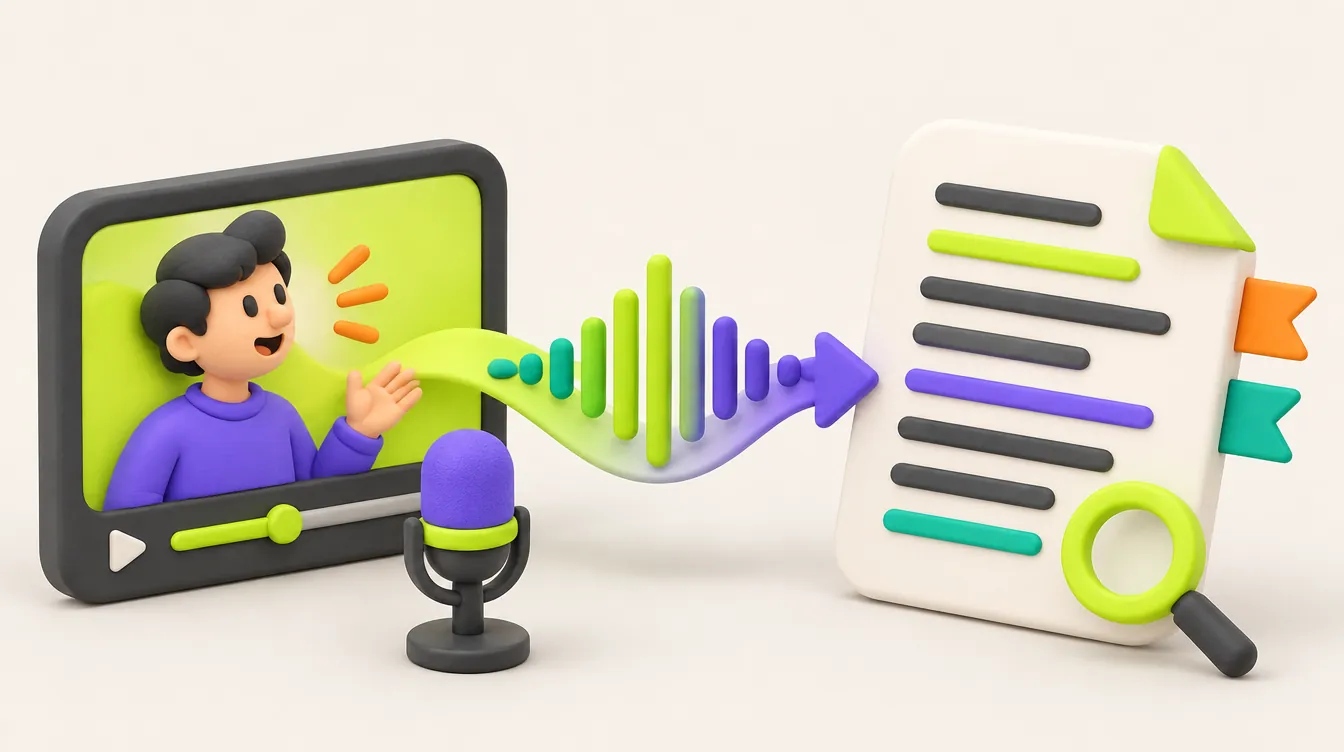
- A YouTube transcript is the video's captions as text segments, each with a start time and duration, plus the language and whether the captions were written by the creator or generated automatically.
- The most valuable minute of any transcript is the first one. Reading the opening 30 seconds of a competitor's best videos side by side shows how they hook viewers better than any metric can.
- Transcripts also find spoken sponsor reads, let you check claims against the exact second they were made, and turn videos into searchable text for articles, Shorts and research.
- Each delivered transcript costs 10 credits in Caelario. Videos with no captions return no transcript and aren't charged.
What a YouTube transcript gives you
YouTube transcripts come from the video's captions. Caelario returns one transcript per video, in the shape below, through the app, the API or the MCP server.
| Metric | What it means | How to read it |
|---|---|---|
| Segments | Short pieces of text, usually a phrase or sentence, each with a start time in seconds and a duration. | The timing is what makes a transcript useful for research: you can cite "at 1:42" and link straight to that moment. |
| Full text | All segments joined into one block. | Use it for search, word counts, summaries and feeding a language model. Keep the segments for anything that needs a timestamp. |
| Language | The caption language returned. | Caelario prefers English captions when a video has them, then other available languages. One transcript is one language. |
| Auto-generated flag | Whether the captions came from YouTube's speech recognition rather than the creator. | Creator captions are preferred when both exist. Auto captions are usually good enough for themes and search but can mangle names, brands and numbers, so check those before you quote them. |
Hook analysis: what happens in the first 30 seconds
YouTube doesn't publish anyone's retention curve, but every creator knows the opening seconds decide whether a viewer stays. The transcript is the closest public record of how a channel spends them. Pull transcripts for a competitor's five best and five most typical recent long-form videos, cut each to the segments that start before 0:30, and read them side by side.
Then label each opening with a few questions. Does it start with a claim, a question, a story or a demonstration? How many seconds pass before the topic in the title is mentioned? Is there a promise of what's coming ("by the end of this video…")? Is there an open loop, a question raised now and answered later? Where does the first sponsor or call to action land? Ten openings labeled this way usually reveal a formula, and comparing the best videos with the typical ones shows which parts of the formula matter.
Count words too. Speaking pace in the first 30 seconds, in words per minute, is easy to calculate from segments and differs sharply between channels: fast, dense openings suit entertainment and news, while slower ones suit tutorials. A sudden change in pace across a channel's recent uploads often means a new editor or a new strategy.
Reading the structure of a famous talk from its transcript
We pulled the transcript of Steve Jobs' 2005 Stanford commencement address from Stanford's YouTube channel: one request, 10 credits. It came back as 244 timed segments and 12,131 characters of text, from a human-made caption track rather than auto-generated captions. Using only the segment start times, we mapped where each part of the talk begins and how long it runs.
Shares of speaking time from 0:22 to 14:35.
See the full table
| Part of the talk | Starts | Runs for | Share of the speech |
|---|---|---|---|
| Channel intro card, then applause | 0:07 | about 15 s before speaking | — |
| Opening and the promise of "three stories" | 0:22 | 0:33 | 3.9% |
| Story 1: connecting the dots | 0:56 | 4:43 | 33.2% |
| Story 2: love and loss | 5:39 | 3:27 | 24.3% |
| Story 3: death | 9:05 | 4:04 | 28.7% |
| Closing: the Whole Earth Catalog and its farewell line | 13:10 | 1:25 | 10.0% |
What it tells you
- The structure is announced 26 seconds into the speech: three stories, nothing more. Everything after that follows the promise, which is why the talk is easy to follow and easy to quote.
- The three stories are similar in length (3.4 to 4.7 minutes each). If you are studying talks or long videos, segment start times let you measure that balance without watching.
- The closing line is said three times in the last half-minute of the speech. Repetition near the end is easy to find in a transcript: search for phrases that appear more than once in the final minute.
- Speech runs from 0:22 to 14:35, about 852 seconds, for roughly 2,200 words: about 155 words a minute, a comfortable speaking pace. Characters ÷ 5.5 is a fair rough word count for English captions.
Part boundaries are the start times of the segments where each section begins; lengths run to the start of the next section, minus pauses where the caption track shows them. Shares are of the speaking time from 0:22 to 14:35. Short phrases are quoted only as labels.
Sources: The video on YouTube
Five ways to use YouTube transcripts
- 1
Hook and structure analysis
Compare openings and chapter structure across a competitor's best and typical videos, as above. Look for the formula, then for the differences between the hits and the rest.
- 2
Finding spoken sponsor reads
Many sponsor reads are spoken but never written in the description. Search the transcript for "sponsor", "thanks to", "use code" and "link in the description". The segment times also show where the read sits (often 60 to 90 seconds in) and how long it runs. See the YouTube sponsorship tracker guide for the description side.
- 3
Checking claims
When a creator reviews your client's product or makes a claim about your category, the transcript gives you the exact words and the second they were said. Respond to what was said, link to the moment, and quote only what you need.
- 4
Repurposing content
For your own or your client's videos, a transcript is the raw material for blog posts, newsletters, show notes, quote cards and Shorts. Segment timings tell an editor exactly where to cut a clip.
- 5
Search and research at scale
Pull transcripts for a set of videos and you can search what an entire niche says about a topic, count how often a brand or feature is mentioned, or feed the text to Ask AI to compare messaging across channels.
Mistakes to avoid with transcript data
Quoting auto captions without checking
Automatic captions mishear brand names, numbers and technical terms. Check the auto-generated flag, and listen to the moment before quoting anything that matters.
Republishing someone else's transcript
A competitor's script is their work. Analyze it, summarize it and quote short phrases with a link; don't publish it in full or rewrite it as your own content.
Reading one video as a strategy
One transcript shows one video. Patterns need five to ten, chosen on purpose: the best performers and typical ones.
Losing the timestamps
If you flatten a transcript into plain text too early, you lose the ability to cite and link moments. Keep segments in your export.
Getting YouTube transcripts with Caelario
A YouTube transcript costs 10 credits per delivered transcript, one video per request. Nothing is charged when a video has no transcript. New workspaces start with 200 free credits, enough for 20 transcripts.
In the app
Paste a video link to get the transcript, or add one link per line to pull several. Download the segments, or ask Ask AI to summarize the video, list its claims or compare the openings of several videos.
Pair it with channel data
Find the videos worth reading first: pull the channel's recent uploads, rank long-form videos by views against the median, and take transcripts of the top and the typical ones. The YouTube channel analytics guide shows how.
API
Developers call the YouTube transcript operation with a video URL or ID and get the language, the auto-generated flag, the full text and timed segments as JSON.
MCP server
In Claude, the Caelario MCP server can fetch a transcript and answer questions about it in the same conversation, such as "what does the creator promise in the first 30 seconds?"